Behind the scenes
Three of us, a dog, and a hard left turn
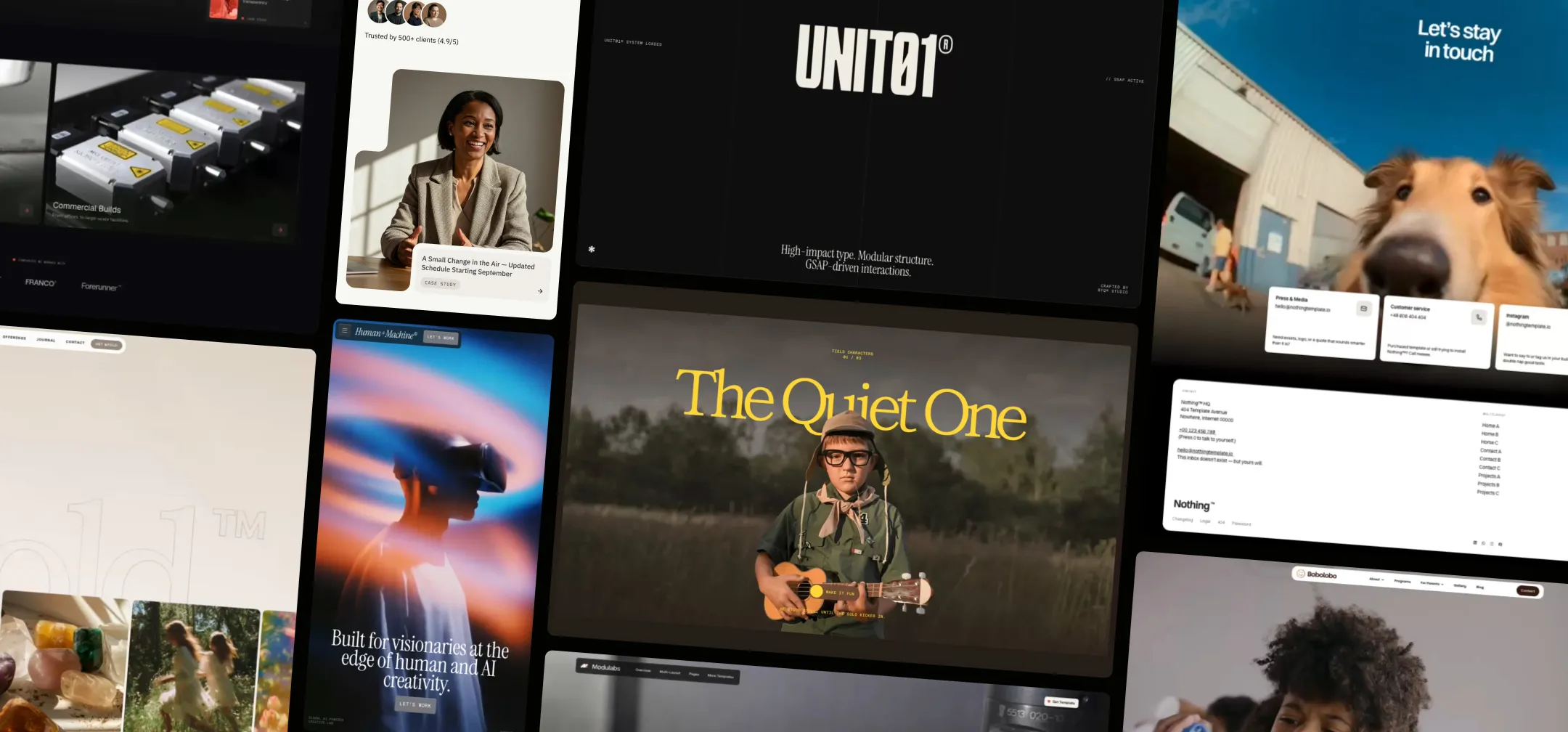
Every template we made contained a hero we'd already built. That observation turned into 2,667 sections and a company none of us planned.

Every template we made contained a hero we'd already built. That observation turned into 2,667 sections and a company none of us planned.
There are three of us. Mike, Martin and Ilona. That's worth saying at the top, because most of what follows sounds like it needed a bigger company than it did.
Two and a half, three years ago we started BYQ Studio. There wasn't a strategy. We loved design, we loved the Webflow workflow, and we wanted to make templates. So we made templates.
That was the whole plan, and for a long time it was enough.
Around the hundredth template, the pattern got impossible to ignore.
Every template needs a hero. Every template needs pricing. Every template needs a testimonial block that doesn't look like a testimonial block. We had solved each of those problems dozens of times, slightly differently, and then buried each solution inside a template where nobody could reach it.
We weren't designing websites. We were designing sections, and then assembling them into websites.
So: if a website is sections, sell sections.
That's not a clever insight — plenty of people had it. What most of them shipped was a dump. A thousand components, no curation, half of them the same card with different padding. A library you have to sift through isn't a library. It's a landfill with search.
Easier said than done, in two ways we badly underestimated.
The platform. BYQ Studio sold templates. BYQ Supply needed to be something — a real product, built on React, which was entirely new territory for us. We learned it while building it, which is exactly as comfortable as it sounds.
The conversion. Turning a hundred templates into sections is not an export. Every section had to be pulled apart, made standalone, and made to work outside the page it was designed for — where it had no siblings to inherit from and no context to lean on. It was an incredible amount of manual work, and there was no shortcut available in 2023.
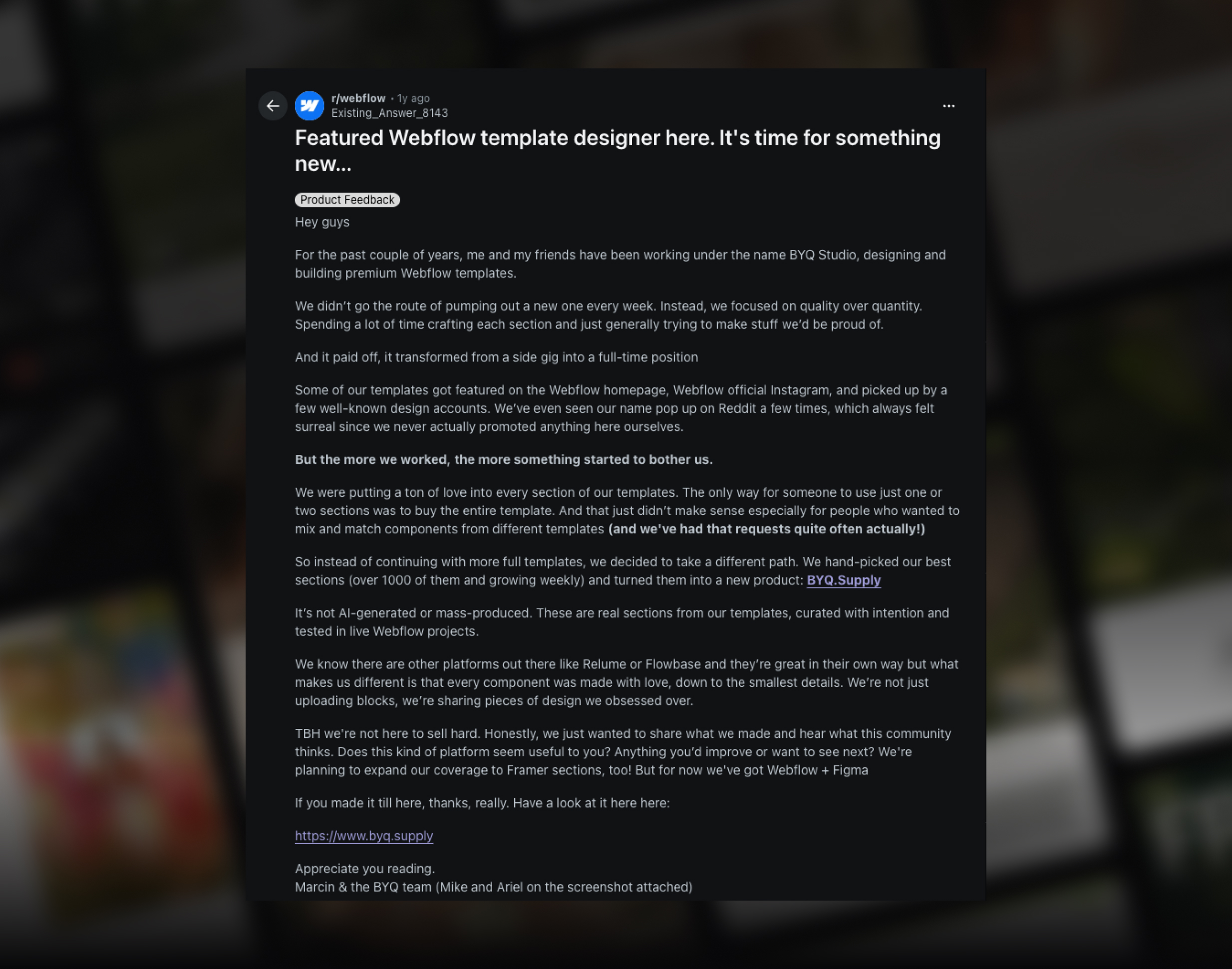
We launched with around a thousand sections. The marketing plan was: tell people on Instagram, and post on Reddit. That was it. That was the plan.
We had subscribers within days. Then a few more the next day, and a few more the day after, and it hasn't really stopped since.
The bigger shift wasn't the product. It was everything around it — being entrepreneurs, doing marketing, maintaining a platform that people now depend on. None of that is designing templates. All of it turned out to be the job.
Skeletons.
The idea was a wireframe library — 285+ low-fidelity sections, structured around variables rather than pasted styling. Our answer to Relume, and honestly, we think the sections in it are more interesting than what was already out there.
Plenty of people use it and get real value out of it. It's a genuinely different way to build, which is what made it hard to make, and also why it sits slightly apart from everything else we do rather than slotting in alongside it.
It's on plan B at the moment. Not because it didn't work — because other things got louder, and there are only three of us. It's still there, it's still good, and we'd like to give it a proper second run. Maybe it makes a comeback. We'd like that.
At some point our vision changed, and it changed fast.
AI stopped being a novelty and started being the thing. Not as a way to generate more sections — anyone can do that, and the internet is now full of the results — but as a new way for people to use the sections we'd already designed.
So we rebuilt what we had, for it.
Templates became design systems. 100+ of them, as DESIGN.md, tokens.json, theme.css and variables.css — some from our own templates, some pulled from brands out in the wild. A design direction, in a format a model can actually read.
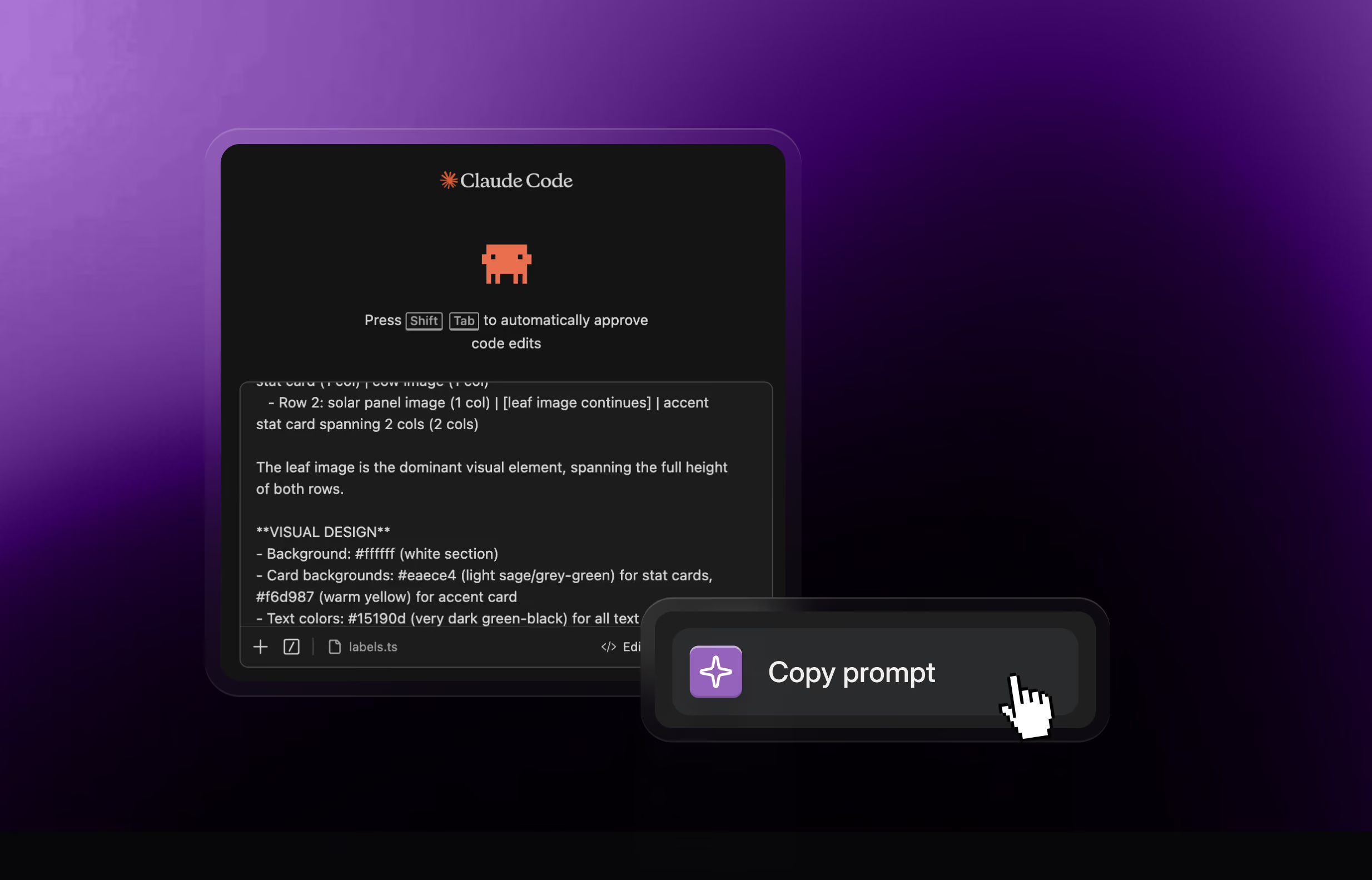
Sections became prompts. Every section in the library copies as a full build spec — real reference code, an explicit instruction to adapt rather than paste, the breakpoints spelled out, the whole thing.
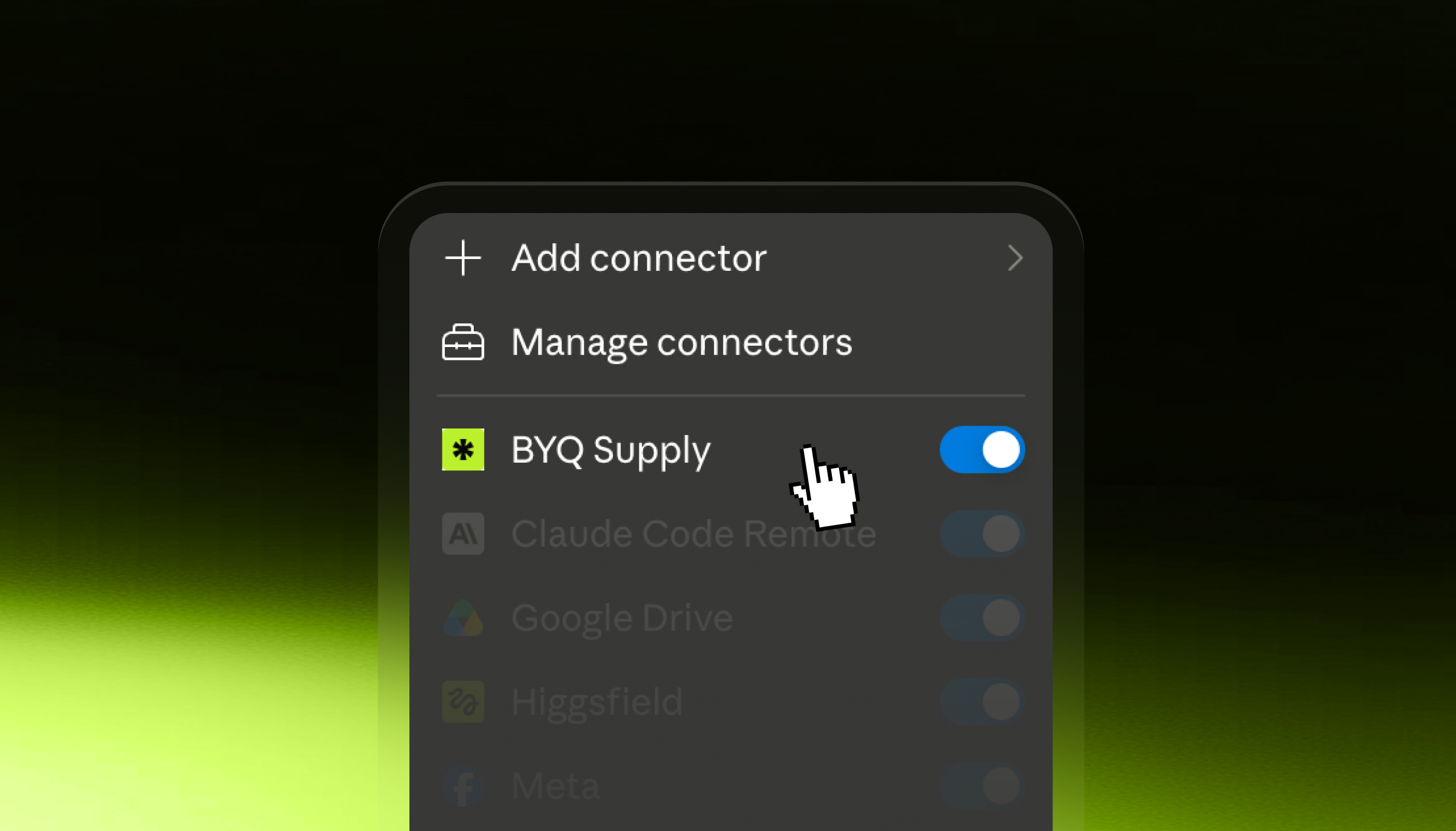
Then the MCP, so agents could reach the prompts and design systems themselves instead of waiting for you to fetch them.
Then whole collections designed with the MCP in the loop — Babka and Kelvin. Not sections converted for AI after the fact. Sections made with it.
And the HTML to Webflow converter, which turned AI-generated markup into native Webflow elements. Webflow's own MCP 2.0 has since made it largely obsolete, and we're fine with that. We'd build it again. Being early sometimes means being early to something that gets replaced.
Mike, Martin and Ilona. In one form or another, that's been true since the first template.
Ilona was there at the start, and then took on the part nobody writes blog posts about: the library itself. Every section, every template, catalogued and added to the database by hand — thousands of them, years before AI could take any of it off her. That work is invisible when it's done well and catastrophic when it isn't.
It's also, it turns out, the reason Shopify was possible at all. You cannot automate the conversion of a mess. The consistency that let us translate thousands of sections into Liquid existed because somebody had been ruthless about it for years, long before there was a payoff in sight.
She's also the one who tells us when something isn't good enough, which is worth more than it sounds.
There have been great designers and Webflow developers alongside us too, on and off. And there's Peanut, who contributes nothing to the roadmap, attends no meetings, and is somehow still essential.
That last part reads like a joke and it's only half of one. A company this small is a fragile thing, and it runs on more goodwill than any org chart would show.
The thing that hasn't changed since the first template: somebody looks at every section before it ships. As AI got better at producing plausible-looking components, that got more important, not less. Anyone can generate two thousand sections this afternoon. That's not the hard part anymore, and honestly it never was.
The hard part is deciding which ones are good.

Four stages. This is how we build, and it's how the pieces are meant to be used.
1. Pick a direction, once. Start with a design system. Tokens, type scale, spacing rhythm, colour roles. One decision, made deliberately, at the point where it's cheap — because the alternative is deciding colour forty times as you go, which is how sites end up with eleven greys.
2. Compose. Sections, from one collection. In Figma, in Webflow by pasting, or in code by prompt or MCP. Staying inside a collection is the single easiest coherence win there is: those sections were designed to sit next to each other. Six sections from six collections gives you six good sections and one incoherent page.
3. Motion, last. Gems, one at a time. A magnetic CTA. A scroll reveal where a section earns emphasis. Motion added at the end is motion you can evaluate. Motion added throughout never sits still long enough to be read.
4. Land it. Into Webflow as native, restylable elements. Into your codebase adapted to your existing conventions. Either way it arrives as something you own and can keep building on — not an embed you can't touch.
Shopify, expanding fast — hundreds of sections converting every week. More on the MCP, including getting Shopify in there.
Beyond that: more platforms. A community that's actually a community rather than a mailing list. And maybe a builder, one day. Who knows.
We didn't plan the first turn either.